Introduction
In one of the best-known images in Western philosophy, Plato describes prisoners who have spent their entire lives chained inside a cave, mistaking the shadows on the wall for the world itself. The allegory has lasted because we tend to imagine possibilities from within the limits of what we already know.
Healthcare now faces a similar problem of imagination. The system most people know is organized around scarcity: too few clinicians, too little time, too much administrative friction, and too little guidance between formal encounters. These constraints are so familiar that they can seem like the natural order of healthcare rather than design choices made under pressure. The structure of the system reflects a long-standing reality: expert attention and administrative capacity are finite, expensive, and hard to distribute.
Abundance in healthcare means relaxing the constraints that have long forced the system to limit access, defer work, and spend too much of its capacity on administration rather than care. AI has the potential to expand the frontier of human health and bring care that is out of reach today to people everywhere, at a fraction of the cost. Today, scarcity determines who waits three months for a specialist and who waits three weeks, who receives sustained attention and who receives a rushed annual visit, and how much clinician and staff time is lost to tasks that do not require human judgment. These are tradeoffs created by limited expert time, high marginal cost, and operational friction. If the cost of reasoning and coordination falls sharply, healthcare can begin to deliver forms of support it could not previously afford: care that is more continuous, intervention that comes earlier, evidence that accumulates from routine practice, and treatments that are not economical to develop today. Each of those possibilities points toward the same end, which is helping people stay healthier for longer.
Only a few years ago, it would have been difficult to imagine that a person could carry 24/7 clinical intelligence in their pocket, available at little or no direct cost and able to answer complex questions in ordinary language. That future has already begun to appear, even if its first forms are imperfect, unsettled, and at times poorly integrated into the institutions that must eventually govern them. A patient can get a first layer of medical guidance at midnight instead of waiting days for basic clarity, a clinician can enter an appointment with the relevant history already organized, and an administrator can automate documentation and billing work that now consumes a large share of healthcare labor. These uses are early and do not solve the deeper problems of healthcare on their own, though they point toward a system in which intelligence becomes more continuous and less confined to scarce encounters.
This future is within reach, although it is far from guaranteed. Healthcare has adopted major technologies before and still became more expensive, fragmented, and difficult to navigate. Like the prisoners in Plato’s cave, we may be seeing only the first outline of a larger world. The task is to understand what those first signs mean, and to build deliberately toward a healthcare system no longer defined by scarcity.
The Case for Healthcare Transformation
The case for healthcare transformation begins with a basic economic fact: the current trajectory is unsustainable. Since 2000, the price of hospital services has risen more than 200%, the steepest increase among the major consumer categories tracked by the Bureau of Labor Statistics, ahead of college tuition and childcare. Medical care services rose roughly 125% over the same period, well above the 74.4% increase in overall consumer prices. And unlike cyclical price pressures, this divergence has compounded steadily for over two decades, pointing to a systemic rather than temporary strain1.
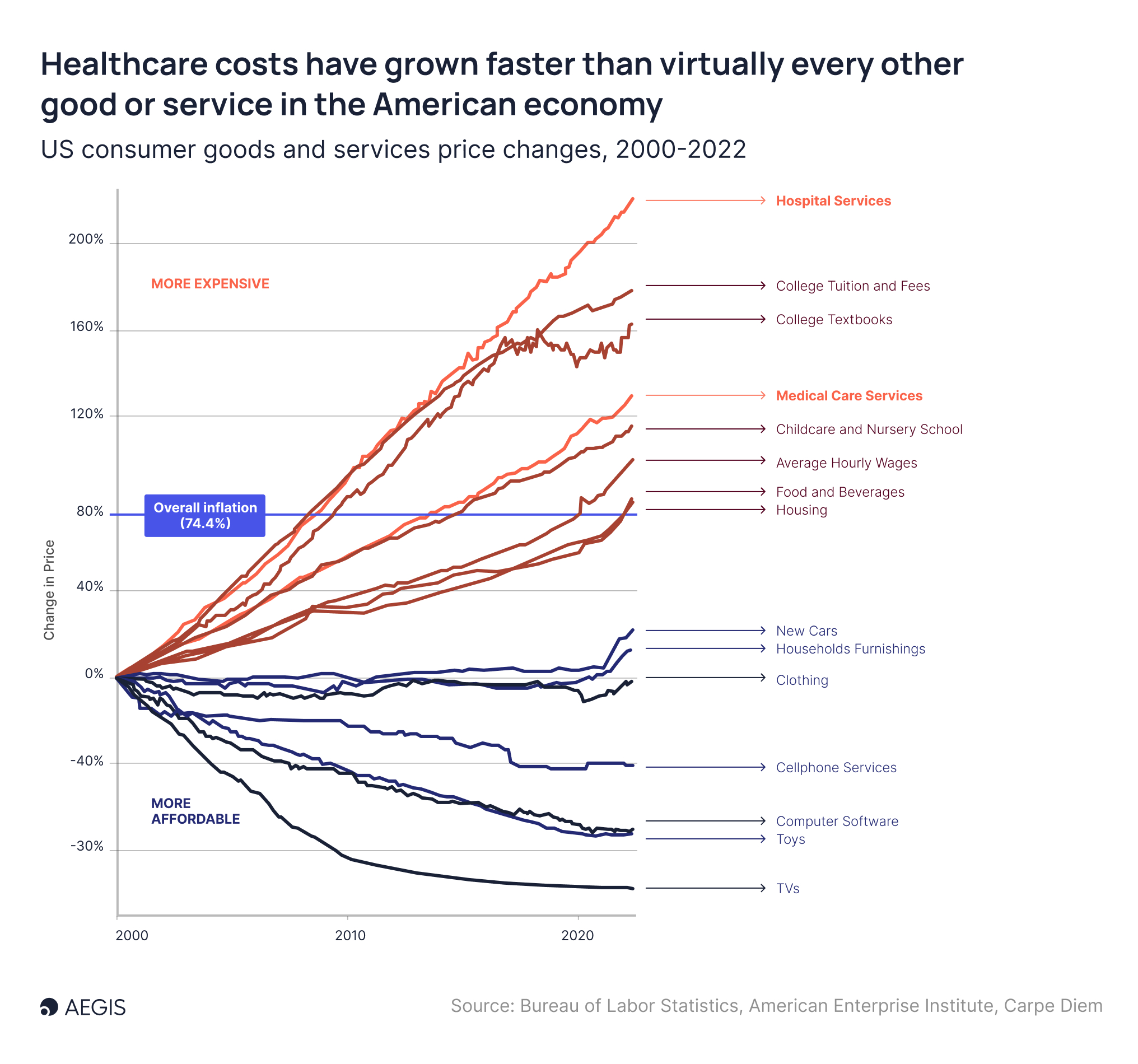
The contrast with technology-driven sectors makes the pattern clearer. Over the same period, televisions, software, and cellphone services have fallen 40-80% in price, the natural result of industries where productivity gains are passed through to consumers. Healthcare has moved in the opposite direction, and the macro picture reflects this trend, with the U.S. leading the world in healthcare spend as a percentage of GDP. CMS actuaries project that national health expenditures will grow 5.8% annually through 2033 against 4.3% growth in GDP over the same period, lifting healthcare from 17.6% of the economy in 2023 to 20.3% in 20332.
A large share of that spending never reaches patient care. Analysis published in JAMA estimated that 25% of all U.S. healthcare spending, nearly $1 trillion annually, is waste, with administrative complexity identified as the single largest category3. Every hour spent documenting, coding, authorizing, and reconciling is an hour that cannot be spent on diagnosis, communication, follow-up, or patient support, which makes administrative complexity both a financial problem and a care delivery problem. It is also one of the clearest places where automation and AI-enabled reasoning could create measurable relief.
Cost and complexity would be serious enough on their own. However, they are colliding with a workforce that is already under strain. The U.S. faces a projected physician shortfall of as many as 86,000 by 2036, driven by a population aged 65 and older growing 34% over the same window while more than a third of the current active physician workforce reaches retirement age4. Nearly 42% of physicians reported at least one symptom of burnout in 20245, and the most commonly cited drivers are excessive administrative burden and ineffective EHR systems, both of which are directly addressable through AI6. Demand is rising and supply is tightening at the same time.
Taken together, these trends show why incremental improvement is unlikely to be enough. The same period that saw healthcare costs compound, administrative burden expand, and physician supply tighten has also produced a remarkable and still-accelerating development in artificial intelligence. When the cost of reasoning, documentation, and coordination falls, the same clinical hour can reach more patients and the same budget can purchase more care. Whether that gain reaches people as shorter waits, lower prices, or more time with a clinician depends on how institutions choose to use it and on how care is paid for.
The Abundant Future is Possible
Imagine a patient who no longer has to guess whether a symptom is worth a doctor’s visit. They have an AI care companion that is always available, grounded in the best available medical evidence, and connected to the relevant record of their health. It knows their medical history, medications, labs, family history, and the daily signals they choose to share from wearables or home devices. It has watched their health unfold over time, rather than glimpsing it during a short appointment once a year. When they have a question at 11pm, they can ask it directly. When a medication needs to be renewed, the system can identify what is needed and route the request without a phone call. When a pattern in their data begins to warrant attention, they can be prompted to seek physician intervention before a manageable issue becomes harder to reverse. Over time those earlier interventions compound, catching conditions before they progress and sparing the patient avoidable emergencies and hospital stays, so that more of their life is spent active and independent rather than managing an illness that could have been prevented.
This is the patient-facing version of abundance. It means that basic guidance does not disappear between appointments. It means that the first layer of clinical reasoning is available in the moments when people usually face the system alone: late at night, after a confusing diagnosis, during a medication change, while caring for a parent, or while deciding whether a child’s fever requires urgent care. The goal is to make the intelligence around care more continuous, so patients arrive at their physical appointments with better context, fewer unanswered questions, and less avoidable uncertainty.
The same shift changes what happens inside the healthcare system. When care does require a human, much of the preparatory work has already been done. Intake is complete. The relevant history has been organized. Symptoms, medications, prior visits, labs, imaging, and risks have been surfaced for review. The clinician walks in with a fuller picture and more time for the work that most needs human judgment: listening, examining, deciding, explaining, and building trust. Instead of asking the physician to hold every detail in memory, the system can make the right information available at the right moment.
Abundance also has an administrative form. In a more capable system, prior authorization, benefits verification, clinical documentation, and referral coordination no longer require patients, clinicians, and staff to push every task through fragmented manual processes. The system begins to handle routine coordination in the background, with human employees focused on exceptions, judgment, and accountability.
Efficiency and abundance are connected rather than opposed, since gains in efficiency can themselves expand capacity, as when an hour returned to a clinician by automated documentation becomes two additional appointments or a follow-up call that would otherwise have been skipped. Reallocating today’s capacity more efficiently, however, still leaves the system working within the same basic constraints: too few clinicians, too few procedural slots, too much administrative work, and too little support between encounters. Abundance begins where those constraints themselves loosen, and as the marginal cost of reasoning, coordination, and routine administrative work falls, the system can begin to deliver forms of support it could not previously afford: earlier detection, closer monitoring, faster follow-up, better navigation, and sustained attention for patients who are currently missed until their needs become urgent.
This future is deliberately illustrative, and it will not arrive simply because the technology exists. The direction, however, is clear. AI is relevant to healthcare because it targets the constraints that have made the system scarce: limited expert time, high cognitive load, fragmented information, administrative work that consumes clinical capacity, and, over time, the physical bottlenecks of care delivery itself.
Where Abundance Shows Up
Healthcare abundance will not arrive as a single event. It will appear layer by layer, as constraints the system has long treated as permanent features of medicine become unlocked by continuous improvements in technological capability. The five layers below run from the informational to the physical, providing examples of where we see AI unlocking meaningful improvements to the patient, provider, and overall health system.
1. Attention
A patient receives clinical judgment when they have an appointment. The encounter rations attention twice over, first by determining who gets time at all, and then by consuming much of that time with retrieval and documentation that must happen while the patient is in the room. Between visits, the system has minimal presence, so medication adherence, symptom escalation, post-discharge recovery, and behavioral change unfold over weeks in which nobody is watching. Abundance at this layer means attention becomes continuous rather than episodic: guidance exists in the hours when people usually face the system alone, the encounter begins with the history already organized, and a care team extends to its full panel the follow-up it can currently offer only to its highest-risk patients.
Caregentic operates in that interval between encounters, carrying outreach, monitoring, and escalation without requiring the patient to initiate. We expect follow-through between visits to be among the first places where AI produces outcome improvements measurable in claims data rather than in workflow metrics alone.
2. Expertise
Access to specialist judgment is rationed by referral and by geography. A patient who needs an eye exam, a skin lesion read, or a cardiology opinion depends on a referral they may never complete, and a finding that is never made cannot change a course of treatment. Abundance at this layer means interpretation moves to the point of care, and specialists oversee more patients than they could personally see.
Optain brings retinal imaging and diabetic retinopathy screening into the primary care visit, so that a diabetic patient is screened where they already are. AI grading makes that screening practical for a primary care team to perform and act on during a routine appointment. As interpretation becomes routine rather than scarce, the range of conditions screened for widens as well.
3. Coordination
Prior authorization, benefits verification, referral management, and documentation are rationed by staff capacity, leading to delays to patient care and treatment. This is the layer where cost can be clearly quantified, driven by the need to allocate staffing resources to tasks that can be automated or offloaded. Abundance here means routine coordination runs in the background while people handle exceptions, judgment, and accountability.
Ascertain automates prior authorization and revenue cycle work that health systems currently staff by hand. Coordination improvement requires relatively less clinical evidence, translating to a faster pace of growth and implementation across the industry.
4. Evidence
Access to clinical knowledge across healthcare ecosystems is rationed as well. Which early finding actually mattered, which patients respond to which treatment, and which interventions change outcomes are questions answered by trial capacity and by records that cannot easily be linked across institutions. Development cost sets a related limit, since a therapy that cannot recover a decade of spending does not get pursued, and rare conditions and smaller populations fall below that bar. Abundance at this layer means routine care begins to generate evidence, and the economics of development change enough to bring more diseases within reach.
Avandra gives model developers access to imaging archives at leading health systems without the scans leaving those institutions, since the analysis runs inside each system’s own environment through a federated network and only the trained model is shared. Access alone does not reveal what an early finding meant for the patient, which takes a second step: inside each institution, a scan is matched through the patient’s own record to that same patient’s later pathology, diagnosis, and treatment, so a model can learn how the case ultimately resolved. Upstream of the clinic, AI also compresses target identification and molecule design, and although clinical trials remain a binding constraint on development timelines, advances in AI will continue to unlock efficiencies in therapy discovery.
5. Capacity
The last layer is physical. Beds, operating rooms, procedures, and hands-on care are limited by facilities and by the people who staff them, and no amount of cheaper reasoning relieves those limits directly. Abundance here would take the form of hospital-at-home infrastructure, expanded scopes of practice supported by real-time expert guidance, autonomous medication management, and eventually robotic or semi-autonomous procedures. This layer requires the most capital and the most institutional trust, and some forms of hands-on medicine will remain human-led for a long time.
Taken together, the layers reinforce one another. For the patient described earlier, continuous attention surfaces a pattern requiring a closer look, expertise helps interpret it, coordination turns that interpretation into a follow-up visit, and capacity determines what care is available when they arrive, while evidence from how the case resolves can inform the next patient’s decision. Earlier detection tends to matter most when the care it points toward is within reach. Whether those layers arrive rests on a prior question, which is whether the technology is capable enough, reliable enough, and adopted widely enough to carry them.
Toward Abundance
The case for abundance as a concrete solution to healthcare’s deep-rooted challenges rests on a simple premise: the technology has to actually work. Across image recognition, reading comprehension, mathematical reasoning, code generation, and other task categories, AI has progressed from near-zero to human-level performance, with many crossing that threshold between 2016 and 2024. The progression has not been linear, and capability gains have accelerated sharply in the last five years, compressing what might have taken decades into a handful of years7.
AI capabilities are advancing across tasks relevant to healthcare

Healthcare is positioned to benefit from this progression in direct ways. The capabilities AI has developed fastest (e.g., nuanced reasoning, interpretation of complex information, and synthesis across domains) are the same ones clinical work demands when a physician weighs competing explanations against the available evidence and decides under time pressure. Operational work calls on those same capabilities, applied to the reading, routing, and reconciling that hold a fragmented system together. AI is relevant to healthcare because the technology has advanced fastest in the kinds of reasoning and information work that make the system both powerful and expensive.
Healthcare also requires evidence that AI can move from laboratory performance into regulated clinical use. The FDA’s authorization track record offers one concrete measure of that transition. In 2015, the FDA authorized just six AI-enabled medical devices. By 2023 that number had reached over 220, surpassing 1,000 total authorizations by the end of 2024, a 37-fold increase in under a decade. The majority of authorizations have concentrated in radiology and cardiology, the highest-volume and highest-cost diagnostic specialties, where the clinical and economic case for AI-assisted interpretation is strongest8.
FDA authorization of AI medical devices has grown nearly 40-fold in a decade
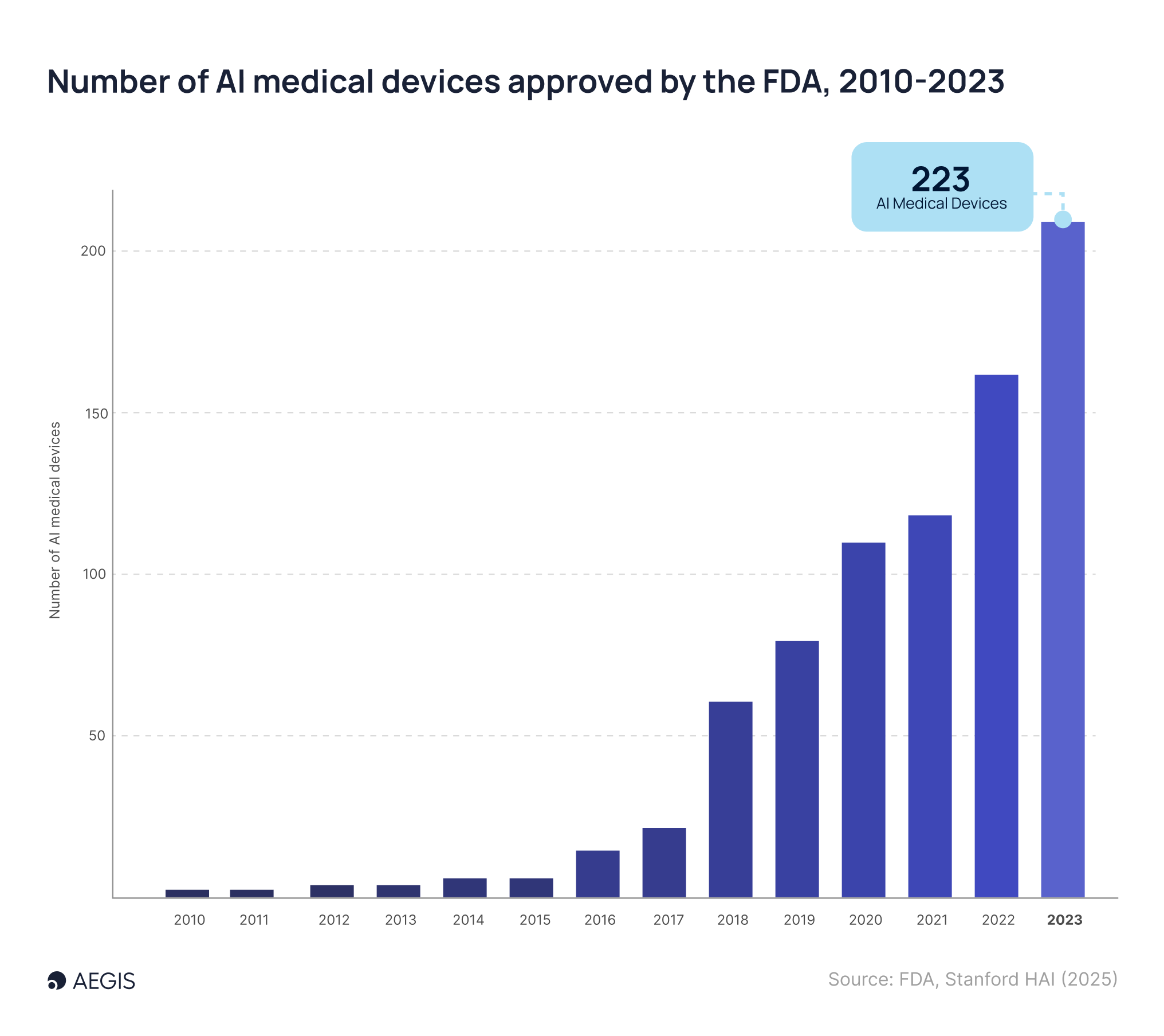
The growth in authorizations does not mean that every tool will be transformative, though it does indicate that the regulatory pathway for AI-enabled medical tools is maturing, and regulatory uncertainty has historically been a leading barrier to adoption. Authorization measures whether a tool is safe to deploy rather than whether it performs across the full complexity of clinical practice, which includes incomplete histories, patient preferences, physical examination, social context, liability, follow-through, and trust. For that reason, AI’s role should be to work alongside physicians rather than stand in for them, and for a system facing a shortage of tens of thousands of doctors, the goal is to expand the impact of the existing workforce.
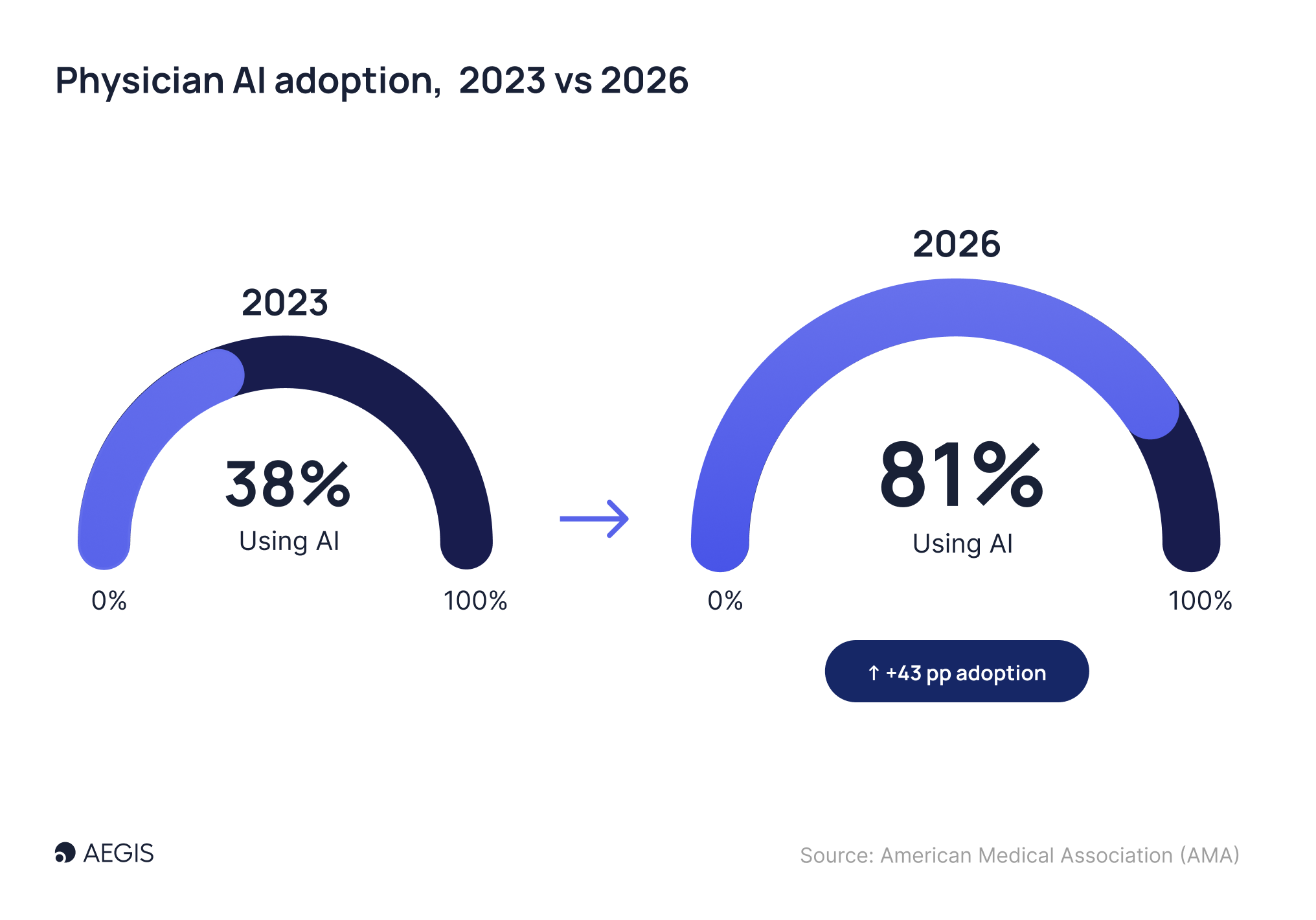
Regulatory authorization indicates what is permitted, while adoption indicates what clinicians actually use, and physicians have not waited for the system to change around them. Physician AI adoption has more than doubled in three years, rising from 38% in 2023 to 81% in 2026. More than three-quarters of physicians now believe AI improves their ability to care for patients, up from 65% just three years prior9.
Physicians are rapidly embracing AI as a tool to expand capacity and improve care delivery
The pattern of adoption also matters. The most common applications today are summarizing medical research, generating clinical documentation, and supporting diagnostic reasoning. By accelerating each of these tasks, AI frees up physician time that can be redirected toward direct patient care and improved clinical outcomes. Seven in ten physicians see AI as a meaningful tool for reducing the burden that drives burnout, addressing one of the primary forces pushing physicians out of the workforce at a time when the system can least afford to lose them.
Adoption describes what clinicians use, while trial evidence shows what that use produces. In the MASAI trial, nearly 106,000 women in Sweden’s national screening program were randomized to AI-supported mammography screening or to standard double reading by two radiologists. AI-supported screening detected 29% more cancers with no increase in false positives while reducing the screen-reading workload by 44%10. Final results reported a 12% lower rate of interval cancers (i.e., those diagnosed between screening rounds), including 27% fewer of the more aggressive subtypes11. This was one vendor’s system running inside a single national program where two radiologists read every mammogram, which is the European standard rather than the single-reader workflow used in the United States. Even so, the result shows both halves of the argument at once: disease found earlier and scarce specialist time returned to other work
None of this guarantees transformation, since healthcare has often turned promising technology into additional cost and complexity. The technical and institutional foundations for AI-enabled abundance are beginning to exist, though capability alone will not carry them into practice without evidence that these tools improve care, governance that makes their use accountable, and payment models that reward prevention and follow-through.
Building those conditions is a shared task: health systems and builders can develop new approaches to care together and show that they improve outcomes, payers and policymakers can make those advances affordable and widely available, and investors can supply the capital to expand them. What allows each group to commit is trust earned in specifics, meaning evidence generated in the settings where a tool will be used and clarity about who validates its performance, who is accountable when it fails, and who shares in the gains.
Conclusion
The pressures on U.S. healthcare now compound on one another: cost growth that outpaces the broader economy, administrative overhead that consumes a large share of total spending, and a physician workforce strained by demands that have little to do with patient care. What has changed is that the case for transformation is no longer only aspirational, with AI capabilities advancing across the tasks that clinical and operational work depend on, regulatory infrastructure adapting in parallel, and physicians already using these tools in daily practice.
Plato’s cave reminds us how difficult it is to imagine a world beyond the one we have inherited. For decades, healthcare has treated scarcity as a fact of life. The patient described earlier shows what loosening it would mean in a single life: a finding caught early rather than late, treatment that begins before a condition becomes hard to reverse, and years spent active and independent rather than managing an illness that could have been prevented. Multiplied across a population, that is the difference between a system that manages disease and one that prevents it.
Realizing that future will require health systems, builders, payers, policymakers, and investors to commit their expertise and their resources to the same purpose. We have a once-in-a-generation opportunity to build a healthcare system that helps people everywhere live their best and healthiest lives. By identifying disease earlier and intervening before it progresses, we can give people more years of health and independence, and more time with the people they love. It is now incumbent upon us to bring the full strength of our institutions, our expertise, and our resources to this shared purpose, and to make the promise of a healthier future a reality for all.